BeritaSeo: Stories

Cats To The Rescue

A BOY aged one has been found living rough on the streets — being kept alive by CATS.
photo credit pixabay.com

The boy, whose ordeal mirrors that of the character Mowgli from Rudyard Kipling The Jungle Book, was discovered by police in Misiones, in Argentina, surrounded by eight wild cats.
Doctors believe the animals snuggled up with him during freezing nights which would otherwise have killed him.
The boy was seen eating scraps foraged by the animals while they licked him, it has been claimed.
Policewoman Alicia Lorena Lindgvist discovered the child by a canal in the Christ King district of the city.
She said: 
"I was walking and noticed a gang of cats sitting very close together. It is unusual to see so many like that so I went for a closer look and that's where I saw him. The boy was lying at the bottom of a gutter. There were all these cats on top of him licking him because he was really dirty. When I walked over they became really protective and spat at me. They were keeping the boy warm while he slept."

The officer, who noticed scraps of food near the boy, added: "The cats knew he was fragile and needed protecting."

Police have found the boy's father who is homeless and said he had lost the boy several days ago while out collecting cardboard to sell. He told officers cats had always been protective of his son.
A spokesman for Thames Valley Animal Welfare, which deals with feral cats and strays in Berkshire, said: "They would have viewed the baby like a big hot water bottle. Cats will cuddle up to anything to keep warm, even dogs.

He added: "In our experience of cat colonies when a mother has a litter, all the other cats will go and fetch food. The baby could have been feeding off the scraps they brought. Cats in Argentina stay in large packs to survive - much more than cats over here."

[source: The Telegraph]

Betty Lou Oliver

Betty Lou Oliver was an elevator operator at the Empire State Building and she survived two major unrelated accidents on the same day!


First when a bomber hit the Empire State Building and then when the elevator that she was in, crashed 80 floors!

What happened?


Disoriented by the fog, the pilot started turning right instead of left, and, as a result B-25 Mitchell bomber crashed into the north side of the Empire State Building, carving an 5.5-by-6.1-metre hole in it.

"I had just started down from the 80th floor, and then there was a noise above me and then a great block of machinery came through the top of my car".

After treating her injuries, first aid workers put her in an elevator to send her down to the main floor.
But the cables of that elevator had been weakened by the crash, and they broke!
And as a result, Oliver plummeted 75 stories to the basement!


The free-fall of the elevator was broken by the massive coils of cables that had fallen to the bottom of the shaft. Despite suffering a broken back and legs, the operator survived.

[sources: Stories of survival and heroism]

Jailbird Turns Into Lovebird

Joseph Andrew Dekenipp escaped by climbing two walls and crawling through razor wire.


Arizona suspect Joseph Andrew Dekenipp went from jailbird, to lovebird, and back to jailbird - all in three hours.

Dekenipp was determined to spend Valentine's Day with his girlfriend.
So much so that he crawled past razor wire, scaled two fences and made his way to a bar about 10 miles away, according to authorities.

Dekenipp went missing Friday afternoon from a fenced recreation yard at the detention center in Florence, according to the CNN affiliate.

When inmates there returned to their residential units, Dekenipp was nowhere to be found.

He'd made the daring escape and was headed to a bar in nearby Coolidge, where he was going to meet his girlfriend.

Pinal County deputies used K-9s to track him, but then his scent disappeared, so they pulled over cars on nearby roadways and searched them.

Their big break came when two teens told authorities that their friend gave Dekenipp a ride to the bar. Deputies hightailed it there, where they found Dekenipp. And no, he wasn't wearing his jail uniform.

Three hours after his escape, his handcuffs clinked shut again without incident. He was hauled back to Pinal County Adult Detention Center.

Dekenipp had been booked in jail last month on various charges, including suspected car theft, unlawful flight and driving on a suspended license, the affiliate reported.

At the time, he was held on a $5,000 bond and had a pretrial hearing set for February 25, according to the affiliate.

The lovebird - and jailbird - may be apart from his girlfriend for a longer period.

In addition to all that, he's now facing an escape charge.

[source: CNN]

The Mighty Poato

Check out this photo of a potato. It may look like a rather ordinary photo, but it’s one of the most expensive photos in the world: it sold last year for a staggering €1,000,000.


The photo, titled “Potato #345 (2010),” is by photographer Kevin Abosch, who charges huge fees to shoot portraits of famous business people in the Silicon Valley tech industry.

“Kevin likes potatoes because they, like people are all different yet immediately identifiable as being essentially of the same species,” his studio tells PetaPixel.

The sale came about when a wealthy buyer who collects Abosch’s work was visiting the photographer’s Paris home in 2015. They saw the photo — a 162x162cm print hanging on the wall and inquired about purchasing it for their collection.

The price was non-negotiable: €1,000,000, but the buyer agreed to the price and purchased the photo, making it Abosch’s largest sale of a single image to date.

The price is a far cry from the $6.5 million that was allegedly paid for Peter Lik’s “Phantom” photo, but the sale price places this photo in the top 20 of most expensive photos of all time.

[source: PetaPixel]

Sidewalk Egg Frying Competition


Residents of Oatman, where temperatures are set to reach 41 degrees today, will compete to see who can cook the most edible-looking egg.


The eggs are simultaneously cracked at noon and after 15 minutes a winner is declared.

Participants can use any solar means necessary including magnifying glasses or mirrors but no fire or electricity is allowed.

A scorching Arizona town is putting the old saying 'hot enough to fry an egg on the sidewalk' to the test.

In an unusual Fourth of July celebration, residents of dusty Oatman, where temperatures are predicted to reach 41 degrees today, will compete to see who can cook the most edible-looking egg.

At high noon, crowds line the streets and the eggs are simultaneously cracked. The 30 or so participants get cooking, using any solar means they choose, whether straight on the cement, or in a fry pan on the ground.

After 15 minutes, Fred Eck, the founder the bizarre tradition, declares the person behind the best-looking fried egg the winner.

The event then wraps up by 1 p.m.

'If we don't, everybody would pass out,' Eck, 69, told NBC News.

Entrants are banned from using fire and electricity to help cook their egg. But they can help the cooking process along with magnifying glasses, aluminum foil, and mirrors.

The eggs need to get to 70 degrees to fry and, despite the phrase, sidewalks are poor conductors of heat, rarely topping 62 degrees even in extreme conditions.

The event, which attracts 200-300 to the town with just 35 shops and a couple of bars and restaurants, began in 1991 during a heatwave and made headlines.

'People thought it was bad publicity for the area because it drew attention to the heat,' said Eck.

'No it isn't, it's who we are. We're in a desert!' 

At first competitors were required to cook their eggs straight on the sidewalk, but the eggs just got stuck, Jackie Murphy, vice president of the Oatman Chamber of Commerce, told NBC.

Then they tried to use the highway as a cooking surface but everyone just got their hands and knees stuck in the bitumen.

'There are probably still knee prints down there,' Murphy said.

But now they've cracked it.

One regular contestant uses an oversize magnifying glass laid horizontally on rollers to cook to perfection not just eggs, but bacon and potatoes, thrilling onlookers.

[source: MailOnline]

Elizabeth(an) Look

Elizabeth was tall and striking, with pale skin and light red-gold hair. She exaggerated these features, particularly as she aged, and other women sought to mirror them.


As Elizabeth aged, her legendary sweet tooth caught up with her, causing her teeth to decay. Her influence by this time was so pervasive that some women went so far as to blacken their own teeth to mimic her appearance.

[source: Royal Museum Greenwich]

Forsaken

A Romanian convict doing time for murder tried to sue God for breaking the contract they allegedly concluded at his baptism and not doing enough to protect him from Satan.
The public prosecutor turned down the case -- because God does not have a home address.


Pavel Mircea, who is serving a 20-year sentence for murder, filed a lawsuit in the western Romanian town of Timisoara against God for not protecting him from the Devil. He claimed that he had concluded a contract with God at baptism but God had not kept his side of the bargain. "He was supposed to protect me from all evils and instead he gave me to Satan who encouraged me to kill," he claimed.
The plaintiff cited five paragraphs from the Romanian criminal code describing the crimes which God had allegedly committed, including fraud, breach of trust, abuse of a position of authority and misappropriation of goods. God had not fulfilled his side of the contract, Mircea claimed, because he had accepted prayers and sacrificial offerings without providing any kind of services in exchange.
The public prosecutor's office in Timisoara turned down the case, arguing that God is not a person in the eyes of the law and does not have a legal residence.

[source: spiegel online]

The British And Their Laws


No armour in Parliament, never handle salmon 'suspiciously' and being drunk in a pub is ILLEGAL: The bizarre Medieval laws that still stand in Britain today


Have you ever been drunk in a pub or shaken a rug out of your window to rid it of dust?

If so, you've broken the law - one of the many obscure decrees first introduced as far back as the 1300s which still stand in Britain today.

Under the Metropolitan Police Act 1839, for example, it is illegal for the 'keeper of a public house to permit drunkenness on premises', yet any pub-goer could swear they see that particular law being broken by millions of people each week.


As of 1313, for example, it has been illegal to enter the Houses of Parliament wearing a suit of armour - which surely hasn't been a likelihood in centuries.


And since 1939, it has been against the law to carry a plank along a pavement.

photo credit Luca Cerabona

As recently as 1986, it has been illegal to 'handle a salmon in suspicious circumstances' - which leaves a lot of room for interpretation.

Steve Blackburn, General Manager of The London Dungeon, said: '800 years ago the Magna Carta enshrined the principles of common law, and since then, thousands of laws have been passed for the greater good.
'But some, which may have been brought in for a really good reason, seem totally bonkers these days. It is understandable that being drunk and disorderly should be an offence, but being penalised for purely being drunk in a pub seems harsh.'
'Some of these laws are truly archaic, but we're using their existence to celebrate the history of our much envied legal system, with a liberal dose of humour and fun.'

As of 1322, it has been illegal for a dead whale found on a British coast to be removed - since it automatically becomes the property of the ruling monarch.

Similarly, it is an offense to let your dog mate with any dog belonging to the royal family - Queen Elizabeth II's corgis thus included.

photo credit Huso

Since 1839, it has been against the law for anyone to fly a kite or slide on ice in the street - perhaps a reasonable safety measure, if a little draconian.

Under the same laws, you are not allowed to erect a washing line across any street either. 
Other forbidden acts which would once have been perfectly rational include riding a bus while (knowingly) suffering from the plague. 

It is also illegal to keep a pigsty in front of your house, unless 'duly hidden', and to be intoxicated in charge of a horse or cow. 

As of 1839, it has also been against the law to beat or shake any carpet or rug in the street. You can shake your doormat, however, but only before 8am in the morning. 

It is also illegal to sing any profane or obscene song or ballad in any street, or to 'willfully and wantonly' disturb people by ringing their doorbells or knocking at their doors - although good luck enforcing that on Halloween!

In Scotland, on the other hand, it is apparently still illegal to turn someone away if they knock on your door and ask to use your loo. 

More recent surprising laws include the official banning of jumping the queue in a Tube ticket hall.

And perhaps our favourite: the Polish potato ban.
As of 2004, 'no person shall import into England potatoes which he knows to be or has reasonable cause to suspect to be Polish potatoes'.

[source: MailOnline]

A Little Knowledge is A Dangerous Thing...indeed

Under Chairman Mao, every Chinese family was obliged to kill a sparrow a week to stop them eating all the rice. The project was ineffective because sparrows don’t eat rice.


The Great Sparrow Campaign also known as the Kill a Sparrow Campaign , and officially, the Four Pests Campaign was one of the first actions taken in the Great Leap Forward (an economic and social campaign by the Communist Party of China (CPC) from 1958 to 1961. The campaign was led by Mao Zedong and aimed to rapidly transform the country from an agrarian economy into a socialist society through rapid industrialization and collectivization.) from 1958 to 1962. The four pests to be eliminated were rats, flies, mosquitoes, and sparrows. The extermination of the last upset the ecological balance, and enabled crop-eating insects to proliferate.

By April 1960, Chinese leaders realized that sparrows ate a large amount of insects, as well as grains. Rather than being increased, rice yields after the campaign were substantially decreased. Mao ordered the end of the campaign against sparrows, replacing them with bed bugs in the ongoing campaign against the Four Pests. By this time, however, it was too late. With no sparrows to eat them, locust populations ballooned, swarming the country and compounding the ecological problems already caused by the Great Leap Forward, including widespread deforestation and misuse of poisons and pesticides.


[source: qi.com]

English sweating sickness

In the 15th century, English ‘sweating sickness’ killed thousands of people and then disappeared;
nobody knows what it was.
Early Modern England

The last outbreak occurred in 1551, after which the disease apparently vanished. The onset of symptoms was dramatic and sudden, with death often occurring within hours. Though its cause remains unknown, it has been suggested that an as yet unknown species of hantavirus was responsible for the outbreak.

[source: Wikipedia]

67%

Women in Switzerland won the right to vote in 1971.


Women in Switzerland gained the right to vote in federal elections after a referendum in 1971. A previous referendum on women's suffrage was held on 1 February 1959 and was rejected by the majority (67%) of Switzerland's men.

And if you thought that's all


In 1991 following a decision by the Federal Supreme Court of Switzerland, Appenzell Innerrhoden became the last Swiss canton to grant women the vote on local issues.

UK First Fatal Accident

The first fatal car accident in the UK was caused by a driver going at 4 mph.


Nearly 1.3 million people die in road crashes each year, on average 3,287 deaths a day. So who was the UK's first fatal car accident victim - and what happened?

There were little more than a handful of petrol cars in Britain when labourer's wife Bridget Driscoll, 44, took a trip to the Crystal Palace, south-east London, on 17 August 1896.

"At the inquest, Florence Ashmore, a domestic servant, gave evidence that the car went at a 'tremendous pace', like a fire engine - 'as fast as a good horse could gallop'," it read.
"The driver, working for the Anglo-French Motor Co, said that he was doing 4mph when he killed Mrs Driscoll and that he had rung his bell and shouted."


The car's maximum speed, the inquest heard, was 8mph but its speed had been deliberately limited.
Mrs Driscoll had hesitated in front of the car and seemed "bewildered" before being hit, the inquest heard.
The jury returned a verdict of "accidental death" after an inquest enduring some six hours, and no prosecution was made.

[source: BBC News]

Book/Lovers

Thousands of Latvian book lovers formed a human paper chain across the capital city of Riga in 2014, to help transfer books from the nation’s old library to its new location (1.9 kilometres).
photo credit REUTERS/INTS KALNINS

Some 14,000 people, including children and the elderly, as well as the visitors from Germany, Sweden, Switzerland and the USA, stood in temperatures of minus 12 degrees C to pass some 2,000 books hand to hand over a five hour period to a new library designed by Latvian-born U.S. architect Gunnar Birkerts.

The remainder of the library's more than 4 million books and printed items will be moved by more conventional means.

Oinking for help

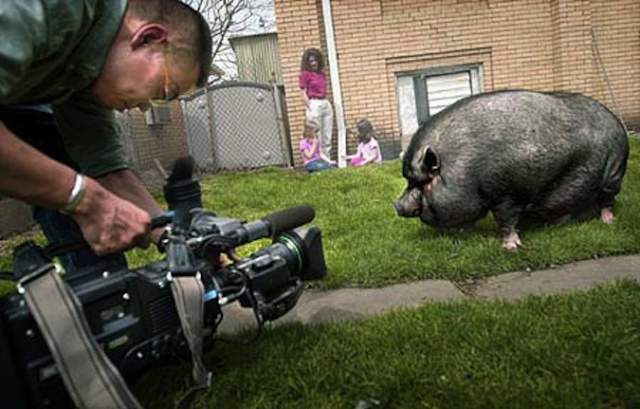
Pot-bellied pig saves owner's life by lying in front of a car


It was just like those "Lassie" episodes where Timmy would injure himself in the wilderness and the ever-loyal, super-intelligent collie would run to town, bark for help and lead rescuers to her master.

OK, it was almost like that.

Except that Jo Ann Altsman of Beaver Falls didn't twist her ankle but had a heart attack. And it wasn't in the wilderness but in the bedroom of her vacation trailer on Presque Isle. And the pet that ran - er, waddled - for help was a Vietnamese pot-bellied pig named LuLu.

When you think about it, LuLu's real-life feat the morning of Aug. 4 was much more amazing than any of Lassie's fictional rescues because she can't bark. That didn't matter. Smart pig that she is, LuLu did the next best thing.

She lay down in front of a car on the road outside the trailer and then led a disbelieving motorist to Altsman, whose ordeal lasted 45 minutes.

Had 15 more minutes elapsed, doctors told her, she likely would have died.
Jack, Ann's husband, was fishing on Lake Erie when had a heart attack, her second in 18 months.

She threw an alarm clock through a window of their vacation trailer at Presque Isle and yelled for help - all to no avail. Bear, their dog, an American Eskimo, just barked.

LuLu cried "big, fat tears," Jo Ann recalled, but she didn't cry all the way home. She knew what to do.

She squeezed through the doggy door and somehow pushed open the gate. According to villagers, she then lay down in traffic.

One nice man eventually stopped and followed LuLu to the trailer. Seeing the cuts LuLu had suffered on her stomach in squeezing through the small doggy door, the man yelled, "Lady, your pig's in distress."

"I'm in distress, too," came the reply. "Please call an ambulance."

Jo Ann was flown to The Medical Center, Beaver, for open-heart surgery.

To this day, the hero has never stepped forward to claim his fame. But LuLu was catapulted to celebrity status, appearing on talk shows and in magazines and books. She snorted at David Letterman and grunted at Oprah Winfrey. Kids loved her, cameras followed her and strangers spoiled her.

And she really could have stood to lose a few kilograms. She was almost 159 kilograms at her heaviest, 113 when she died. But with fans constantly dropping by to give her doughnuts, slices of pizza and Dreamsicles, and LuLu teaching herself to open the refrigerator door and cans of Pepsi, it was difficult to monitor her junk-food intake.

[source: old.post gazette, by Michael A. Fuoco, Post-Gazette Staff Writer, the times, ]

Terracotta Army

The Terracotta Army or the "Terracotta Warriors and Horses" is a collection of terracotta sculptures depicting the armies of Qin Shi Huang, the first Emperor of China.
It is a form of funerary art buried with the emperor in 210–209 BCE and whose purpose was to protect the emperor in his afterlife.

photo credit pixabay.com 

Estimates from 2007 were that the three pits containing the Terracotta Army held more than 8,000 soldiers, 130 chariots with 520 horses and 150 cavalry horses, the majority of which remained buried in the pits nearby Qin Shi Huang's mausoleum.

How did they build so many soldiers? 

To build 8,000 life size statues must have taken a large army of workers. Archeologists estimate that over 700,000 craftsmen worked on the project for several years. The bodies of the soldiers were made in an assembly line fashion. There were moulds for the legs, arms, torsos, and heads. These pieces were then assembled together and custom features such as ears, mustaches, hair, and weapons were added later. 

There are between 8 and 10 different head shapes for the soldiers. The different head shapes represent people from different areas of China as well as different personalities of the soldiers. The heads were made from moulds and then customized and attached to the bodies. 

When was the army discovered? 


The Terracotta Army was discovered by farmers digging a well in 1974, over 2,000 years after it was covered over during the burial of Emperor Qin. The army was located about a mile from the tomb of the emperor. 

Fast Facts

  • China’s first emperor spent much of his life searching for immortality and built himself a tomb complex that encompassed 20 square miles. 
  • Construction of the tomb began when the future Emperor of Qin  took power at the age of 13. 
  • The army took an estimated 40 years to finish.
  • The clay soldiers remained untouched for more than 2000 years, until 1974, when they were unearthed by Chinese farmers.
  • Recent digs have also uncovered terra cotta acrobats, musicians, and waterfowl.
  • Every soldier is unique, no two are alike and each has unique and realistic features.
  • Scientists are using various techniques to preserve the paint found on the warriors.
  • The greatest mystery is yet to be revealed: the Emperor’s tomb, which has yet to be opened.

[source: Wikipedia, ducksters, Children's museum Indianapolis]

Before Rosa Parks

Claudette Colvin (born September 5, 1939) is a pioneer of the African American Civil Rights Movement.


On March 2, 1955, she was the first person arrested for resisting bus segregation in Montgomery, Alabama, preceding the more publicized Rosa Parks incident by nine months.

For a long time, Montgomery's black leaders did not publicize Colvin's pioneering effort because she was a teenager who was pregnant and unmarried. Given the social norms of the time and her youth, the NAACP leaders worried about using her to represent their boycott. 

Early Life

Colvin was born September 5, 1939 and was adopted by C. P. Colvin and Mary Anne Colvin, and grew up in one of the poorer neighborhoods of Montgomery, Alabama. In 1943, at four years old, she had received her first impression on the struggles of segregation. She was at a retail store with her mother when a couple of white boys entered. They asked her to touch hands and compare them. Her mother saw this, slapped her face, and said that she was not allowed to touch them.

Bus Incident


In 1955, Colvin was a student at the segregated Booker T. Washington High School in the city. She relied on the city's buses to get to and from school, because her parents did not own a car. She said that she aspired to be President one day. Colvin was a member of the NAACP Youth Council, and had been actively learning about the Civil Rights Movement in school. Colvin was returning home from school on March 2, 1955, and got on a Capital Heights bus downtown. She was sitting about two seats from the emergency exit in the colored section.

If the bus became so crowded that all the so-called "white seats" in front were filled and a white person was standing, the African Americans were supposed to leave these seats and move to the back and stand, if needed. When a white woman got on the bus and was left standing, bus driver Robert W. Cleere commanded Colvin and three other black women in the row to move to the back. The other three moved, but a pregnant black woman, Ruth Hamilton, got on and sat next to Colvin.

"And so as the bus proceeded on downtown, more white people got on the bus," she says. "Eventually the bus got full capacity, and a young white lady was standing near the four of us. She was expecting me to get up."

The driver looked at them through his mirror. "He asked us both to get up. [Mrs Hamilton] said she was not going to get up and that she had paid her fare and that she didn't feel like standing," recalls Colvin. "So I told him I was not going to get up, either. So he said, 'If you are not going to get up, I will get a policeman.'" The police arrived and convinced a black man sitting behind the two women to move so that Mrs. Hamilton could move back, but Colvin continued to refuse. She was forcibly removed from the bus and arrested by the two policemen, Thomas J. Ward and Paul Headley. This was eight months before NAACP Secretary Rosa Parks was famously arrested for the same offense.


When Colvin refused to get up, she was thinking about a school paper that she had written that day about the local custom that prevented blacks from using the dressing rooms and trying on clothing in department stores. She said in a later interview: "We couldn't try on clothes. You had to take a brown paper bag and draw a diagram of your foot ... and take it to the store.”

"The bus was getting crowded and I remember the bus driver looking through the rear view mirror asking her to get up for the white woman, which she didn't," said Annie Larkins Price, a classmate of Colvin's. "She had been yelling 'It's my constitutional right'. She decided on that day that she wasn't going to move." Colvin was handcuffed, arrested and forcibly removed from the bus. She shouted that her constitutional rights were being violated. Price testified for Colvin in the juvenile court case. Colvin was convicted of disturbing the peace, violating the segregation law, and assault


"…as a teenager, I kept thinking, Why don’t the adults around here just say something? Say it so that they know we don’t accept segregation? I knew then and I know now that, when it comes to justice, there is no easy way to get it. You can’t sugarcoat it. You have to take a stand and say, 'This is not right.' And I did."